Portable Power Station Guides
Three guides cover most backup-power decisions: how big, which kind is safe for your home, and which brand's spec sheet holds up.
What size power station do I need?
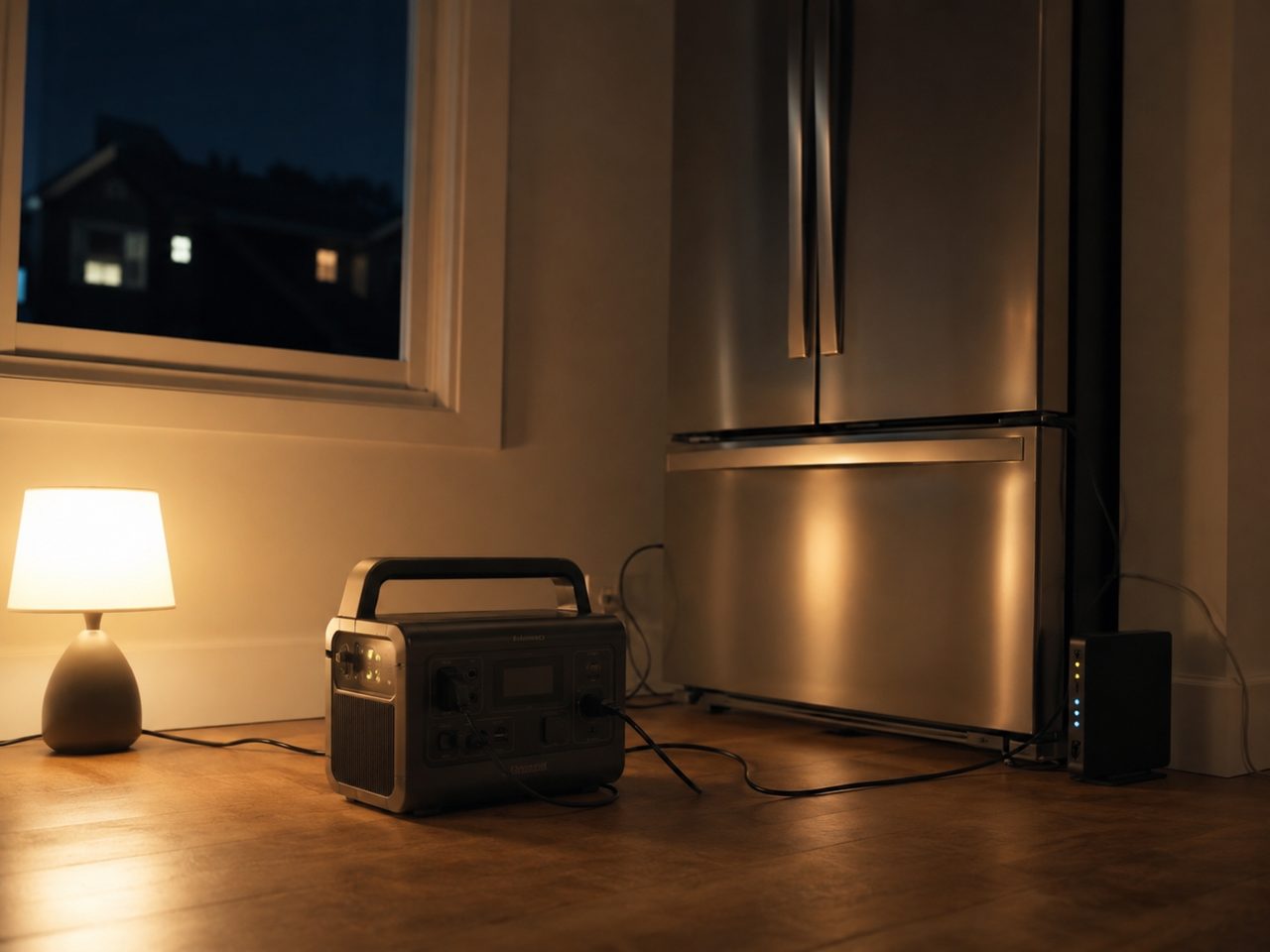
For most homes: the 1–2 kWh class. A 1,024 Wh unit runs a fridge, router, lamps, and phone charging for about 10.5 hours (1,024 × 0.85 usable ÷ ~82 Wh/hour of draw). Phones-and-CPAP-only needs just ~300 Wh; multi-day fridge duty needs 2–3 kWh. The worksheet sizes your exact loads.
Size your power station →Indoor generator for apartments
A gas generator run indoors can kill you — carbon monoxide is not negotiable. Battery power stations are the only safe indoor generator, and the right one covers a fridge, Wi-Fi, and phones through a typical apartment outage with zero fumes and zero noise.
Apartment backup power guide →Bluetti vs EcoFlow
The two spec-sheet heavyweights, compared line by line at the 1 kWh and 2–3 kWh classes — capacity, surge output, UPS switchover, charge speed, cycle life — and which single spec actually decides each class.
See the comparison →How to Size a Power Station: Runtime Math That Holds Up
Every honest runtime estimate uses the same formula — usable capacity divided by real draw. Marketing skips the two correction factors; we don't.
…and the surge rating must beat your biggest startup spike, or the unit trips exactly when you need it.
| On a 1,024 Wh power station (~870 Wh usable) | The math | Runtime |
|---|---|---|
| Refrigerator (modern, mid-size) | 150 W × 35% duty ≈ 52 Wh/h | 12–18 hours |
| CPAP, humidifier off | 40 W × 8 h ≈ 320 Wh/night | 2–3 nights |
| Wi-Fi router + modem | 15 W continuous | ~2 days |
| LED TV (50") | 100 W continuous | ~8–9 hours |
Backup Power for Apartments: Battery, Never Gas
Searching for an "indoor generator"? Every gas, propane, and dual-fuel generator is outdoor-only — CPSC guidance puts them 20+ feet from the building because carbon monoxide kills in minutes indoors. For an apartment or condo, backup power means a battery power station: silent, fume-free, and legal on any floor. Our guide picks by the three specs that matter in an apartment — capacity for your fridge-plus-router night, surge rating for the compressor kick, and recharge options when the outage outlasts the battery.
Read the apartment backup power guide →Power Station Brand Comparisons: Bluetti vs EcoFlow
Brand pages all claim the same thing, so we put the published numbers side by side instead: watt-hours, surge watts, UPS switchover milliseconds, charge minutes, and rated cycle life at the 1 kWh and 2–3 kWh price points. Verdicts flip on price in this category — we have now watched the 1 kWh verdict flip twice in four weeks on price alone — so where that's true we say "buy whichever is cheaper that day" and publish the price history instead of quietly overwriting it.
Power Station vs Generator: Where the Crossover Actually Falls
Not "which is better" — at what point a battery stops being enough. We calculated it from published numbers: a gas inverter generator produces 4.7–6.1 kWh per gallon and gives you roughly 14× more on-hand energy per hardware dollar, while a battery costs less per kilowatt-hour delivered, runs indoors, and makes no noise. For a household-essentials load the line falls near 35 hours of outage — and the efficient setup past that point turns out to be both.
See the crossover math →How SteadyWatts Sizes Backup Power
We are a spec-sheet operation. We compare manufacturer specifications, verified pricing, and published standards — and we tell you exactly which is which. We don't claim to have camped with these units, and we won't describe how a handle "feels." If a recommendation can't be defended with a number, it doesn't go on this site. Prices are timestamped, runtime math is shown in full, and affiliate links are disclosed on every page that carries them.
Read the full methodology →